Monday, January 11, 2021

Down with Idols!

At first glance, the rant of prophet and psalmist against the worship of idols might seem out of date to contemporary readers.  A little reflection, though, tells us that it is as current as can be.  “Idol” is defined in modern dictionaries as a representation of an object of worship, carrying the connotation of “false god”.  Nowadays, with religious idolatry a matter of concern only to select circles,  it is more common to see the title “idol” attached to any person who attracts adulation, regardless of personal qualities, or any perceived good that determines how we live our lives.  Idols are identified by their popularity rather than by what they represent.  A movie star might be an idol, sometimes for no apparent reason, certainly not acting talent. Wealth or power might be a goal to which we render obedience and devote our lives as to a god.  These idols and their implications for people’s lives make countless appearances in the media, enhancing their power over people’s thoughts and behavior, no less than did the idols of Egypt in the days of the Pharaohs, though normally no one would consider them real divinities. 

 The idol we recognize less often is more dangerous.  The psalmist warns, “Pagan idols are silver and gold,/ the work of human hands. They have mouths but they do not speak; /they have eyes but they do not see./ They have ears but they do not hear; /there is never a breath on their lips./ Their makers will come to be like them, and so will all who trust in them!” (Psalm 135:15-18) Think about these idols not in the usual sense of statues or even all-consuming goals, but as the images we have used as models, creating selves made false and rendered lifeless, There are many means at hand to disguise ourselves behind exteriors of silver and gold, the work of our own hands, or the hands of others—makeup, clothing, plastic surgery, clothing designed to convey a desired image, styles of speech or accents not the ones we grew up with, letters after our names, a certain house, a certain car, even appearances of piety.  We have learned how to look good to our chosen audience—parents, children, teachers, employers, co-workers, neighbors, voters, whoever’s good opinion we have come to value above our own integrity.  But skill does not supply reality. The image is an illusion, not the living, breathing human being we really are—or were.  In this case, we have ourselves become idols to ourselves.

 In most cases,  fortunately, we don’t remake ourselves over entirely by the pattern of false images.  But we can take on the bits and pieces of the images and so, to some degree, falsify ourselves. And, with God’s help and the intervention of people who love us as we are, we can outgrow the falsity as we mature. If we look back at the teenager or the twenty-something or the ambitious “newbie” we once were, we can breathe a sigh of relief at having left that “self” behind!

 St. Benedict offers us two powerful tool for abandoning self-falsification and self-worship. The first is humility, which he presents as a process rather than a finished achievement (RB 7).  He might have rooted it in an earlier line:  “Do not aspire to be called holy before you really are, but first be holy that you may more truly be called so” (RB 4:62).  The hidden trick is that if we truly become holy, we will no longer worry about another person’s opinion or seek to make ourselves  look better to impress others because our life will be devoted to Christ who is himself our “truth” (cf. John 14:6), a truth far greater than we alone could ever become.  In a larger sense Benedict’s directive really calls us to be who we truly are right now and seek to become who we will ultimately really be in the next life by the power of God, our real Creator., not some hollow image we have made of ourselves according to some pattern we have thought might be to our advantage.   Each real self is unique.  There are no duplicates in the reign of God, only vivid originals.

 The second tool, more surprisingly, is community in whatever broad sense our way of life provides.  Surrounding ourselves with others committed to the same quest for God as we are, the same values as we aspire to live, and the same ultimate goal we are pursuing, as oblates do, is the best way to protect ourselves from the falsities that might tempt all of us.  A network like this binds us to people who love us enough to offer us inspiration, encouragement, and, yes, honest feedback to keep us on the path integrity. And it invites us to do the same for them.  Human truth is never simply individual; it is always shared in Christ, belong as we all do to the Body of Christ.

 Believe it or not, with Christmas now behind us, Lent is not too far ahead.  Ash Wednesday this year is February 16.  We need not wait.  We could start now to tear down whatever idols we have made of our own gifts, talents, or empty dreams.   How small, tacky and tarnished they appear next to the reality seen in the bright light of Christ!  God much prefers the real thing. So do the people who genuinely love us.  And so, in our best moments, do we. 

 Copyright 2021, Abbey of St. Walburga


Thursday, December 31, 2020

Happy New Year!

 Ah, it’s that time of year.  Time for some introspection and decisions regarding appropriate conversatio morum for the New Year—though only Benedictines would call it that!  Most folks would recognize it better as making New Year resolutions.  St. Benedict doesn’t mention custom specifically, of course, because the holiday-with-resolution project hadn’t been invented yet.  He presumed that conversatio went on all year long, with particular emphasis during Lent.  His idea is probably less fraught with tension than gritting our teeth, putting past flops out of our mind, and drawing up that list many of us make at this season, and sometimes keep for a few days.

There is an approach to decisions about conversatio that is relevant every year and every season.  It draws upon St. Benedict’s ever-fresh urge to listen with the ears of the heart.  I have found that Psalm 1 supplies excellent and challenging guidance here. 

 Here is the version of the Grail translation that we pray at the Abbey:

 Blessed indeed is the man

who follows not the counsel of the wicked,

Nor stands in the path with sinners,

nor abides in the company of scorners,

But whose delight is the law of the Lord,

and who ponders his law day and night.


He is like a tree that is planted

beside the flowing waters,

That yields its fruit in due season,

and whose leaves shall never fade;

and all that he does shall prosper.


Not so are the wicked, not so!

For they, like winnowed chaff,

shall be driven away by the wind.

When the wicked are judged they shall not rise,

nor shall sinners in the council of the just;

For the Lord knows the way of the just,

but the way of the wicked will perish.

The psalmist challenges us not merely to listen but to listen with discernment—another staple quality in the monastic tradition.  Not all the voices that bounce around in our environment or in our hearts are life-giving.  Some would qualify as the wicked, the sinner, the scorners whom St. Benedict, with the psalmist, would call destructive. They might come from our past—the voices of family or teachers or coaches who harped so constantly on our failures that we gave up trying; the voices of video or printed fiction that convince readers that violence is the only way to confront evil (Jesus might beg to disagree); the endless ads that try to persuade us that we are entitled to remain young, beautiful (whether we ever were or not), and successful at any price; the self-help books that teach us how to compete successfully at our chosen work or leisure activities by stepping on the competition on our way up the ladder.  These voices conjure up for me a picture of barkers in a bad carnival, hawking dubious pleasures if only we would just step inside into their tent.   Obey them, the psalmist says, and stability flies out the window.  Instead of being rooted and growing beside the living waters traditionally interpreted as the Scriptures themselves but equally applicable to St. Benedict’s scripture-studded Rule, the indiscriminate listener risks drying up into mere chaff.  Chaff is the dry husks that are separated from the grains of good wheat in the threshing process.  Chaff serves no useful purpose, feeds no one, and blows away in the wind, leaving nothing but dusty scraps on the ground.  This is probably not the goal we are hoping to accomplish as we confront the new year.

 There is, of course, another Voice, the psalmist says.  When it appears as “the law of the Lord” in the first stanza, it may seem as dusty as old law books in a law library.  To those of us who are not scholars and practitioners of the law, they may seem to promise death by boredom rather the delight the psalmist encourages.  But that’s because we fail to recognize the law as God’s Word, the force that creates all life, including ours.  More, the law of the Lord is the law of the covenant.  The enduring covenant between God and humanity is not a set of words—though it first appeared so when Moses brought it down Mount Sinai inscribed on stone tablets.  The ultimate covenant is Jesus Christ, in whom God and humanity have been bound together in one Savior.  In other words, to delight in the law of the Lord is to delight in Jesus Christ, to whom, says St. Benedict, we prefer nothing and in whom we find life at its deepest and best.  In him, we discover our humanity brought to ultimate perfection.  And we are invited not simply to stand back and admire, not simply to worship, but grow as members of his living Body.  That is the reality that undergirds all that St. Benedict has to say about relationships in Benedictine life.  Living in Christ, God’s Word made flesh, we are indeed firmly rooted in the truth about God, about ourselves, about the world around us, like a tree beside running water.  And it’s a fruit tree that provides nourishment for all who come. 

 So, about those resolutions.  Psalm 1 provides the real criterion for making resolutions about what we are called to do, and not to do.  Look down the road at what our resolutions will make us:   chaff or tree, hollow shell or living, fruit-bearing tree?  Our choice.  Before we decide, St. Benedict would advice us listen with the ears of our hearts to the One who loves us.

Copyright 2020, Abbey of St. Walburga


Thursday, December 24, 2020

A Reflective Prayer for Christmas Eve

 Lord, Jesus Christ, I wish I could say all is ready to receive You--stable swept and clean, ox and ass washed down and brushed, nice little wooden manger sanded to ensure no splinters, and filled with fresh straw.  Then it dawns on me that You didn't (and don't) come simply to set Your seal of approval on redemption already achieved (by my own work, of course).  You came (and come) to clean up the mess made over and over again by the sin with which we persist in wrecking the creation intended to offer life to the full.  You came (and come) to heal the wounds we inflict on ourselves and one another. You came (and come) to light up from within the darkness in which we hope to hide all our self-made damage so we won't see it, and neither will You. We don't really want You to come till we're ready to show you a nice world, all clean and tidy.  That Advent prayer, "Come, Lord Jesus"?  We really meant, "Come, but not yet.) But You came and come anyway.  Thank you!

Well, those herald angels are tuning up.  Time for us to tune up too, and sing, and mean it, as best we can: 

Glory to the newborn King!
Peace on earth and mercy mild
God and sinners reconciled"
Joyful, all ye nations rise
Join the triumph of the skies
With angelic hosts proclaim:
"Christ is born in Bethlehem"
Hark! the herald angels sing:
"Glory to the newborn King!"


Wednesday, December 23, 2020

The Loneliest Christmas


Loneliness seems unconnected with Christmas, but it isn’t.  Many will be lonely this year because of very necessary COVID precautions. But, in fact, this COVID isolation casts a spotlight on the isolation and loneliness experienced by many every year, and at all seasons. Christmas draws attention to what a contradiction this is to God’s desire for us. 

 In the mystery of Christ come among us, God has begun the long, slow work of transforming scattered since Eden (see Genesis 1-11 for a capsule account!) into a togetherness of extraordinary depth.  St. Paul calls it the Body of Christ.  It is not spatial or geographical.  It is a gathering of every splinter of fragmented humanity and fragmented individuals into a communion so deep it transcends space and time.  Our Christmas gift to one another, loved ones and strangers alike, is to turn it from theology into experience in whatever small ways we can.  When physical gatherings are impossible, we already know and are making use of phone calls, virtual conversations, e-mails and notes, but that nonphysical network includes only those we know and love.  Let us not forget the power of a more powerful network, the network created by God in Christ, and strengthened by attentive awareness expressed in prayer.  It seems like nothing, I know, and it satisfies no desire to see the kind of results we might get from staffing a soup line or taking baskets to poor families.  It’s a gift that expects no return, something that the promoters of a commercialized holiday could never understand.  And we can’t exactly understand it either, but we are invited to believe in it with the faith that is God’s great gift, or one of them.

 St. Benedict urges us to seek God in all things, not just the nice things that come tied up in bows. This year the grace of Christmas might be to seek and find small hints of the ultimate togetherness given us as gift in Christ. One of the places we might have to look is in the very separation, isolation and loneliness of this particular Christmas.  What we are looking for, really, is threads of light that can still be seen drawing people together in the very depths of things: the courage of those who suffer, the mutual concern among strangers in odd places, the steadfast perseverance of those who refuse to believe that loneliness is all that is possible.  What we are looking for is sparks and candle flames, not bonfires.  Christ arrived on the bleak human scene  not as monarch enthroned in power and glory but as a newborn child in an unknown backwater of the Roman empire who might have been cute, as newborns are, but who certainly didn’t seem to be of any particular import to anyone but Mary and Joseph.  Looks deceive, even the look of loneliness that hides our real and becoming togetherness. 

 St. Benedict also offers clues as to what our togetherness might actually look like.  Read Chapter 4 and Chapter 72. Neither offers grandiosity or drama.  Both require a good bit of reinterpretation for life beyond a sixth-century monastery of men. And they require work. Prayer is a pretty good tool for seeing what lies beneath the surface of our present COVID-limited Christmas, and our perennial struggle with everything that contradicts the experience (but not necessarily the reality) of that togetherness which is the hidden goal of every Christmas, for every person on earth.  This might make good food for thought and conversation for oblate groups who are making the best of creative ways of meeting and sharing in defiance of the blanket of isolation and loneliness that seems to envelop so much and so many this year.

 One verse of the old favorite seasonal hymn, “O Come, O Come, Emmanuel” reads:

O come, Desire of Nations bind

In one the hearts of humankind.

O bid our sad divisions cease,

And be for us our King of Peace.

He will, whether we recognize him at work or not.   Emmanuel means God-with-us.  And God means that.

 Copyright 2020, Abbey of St. Walburga
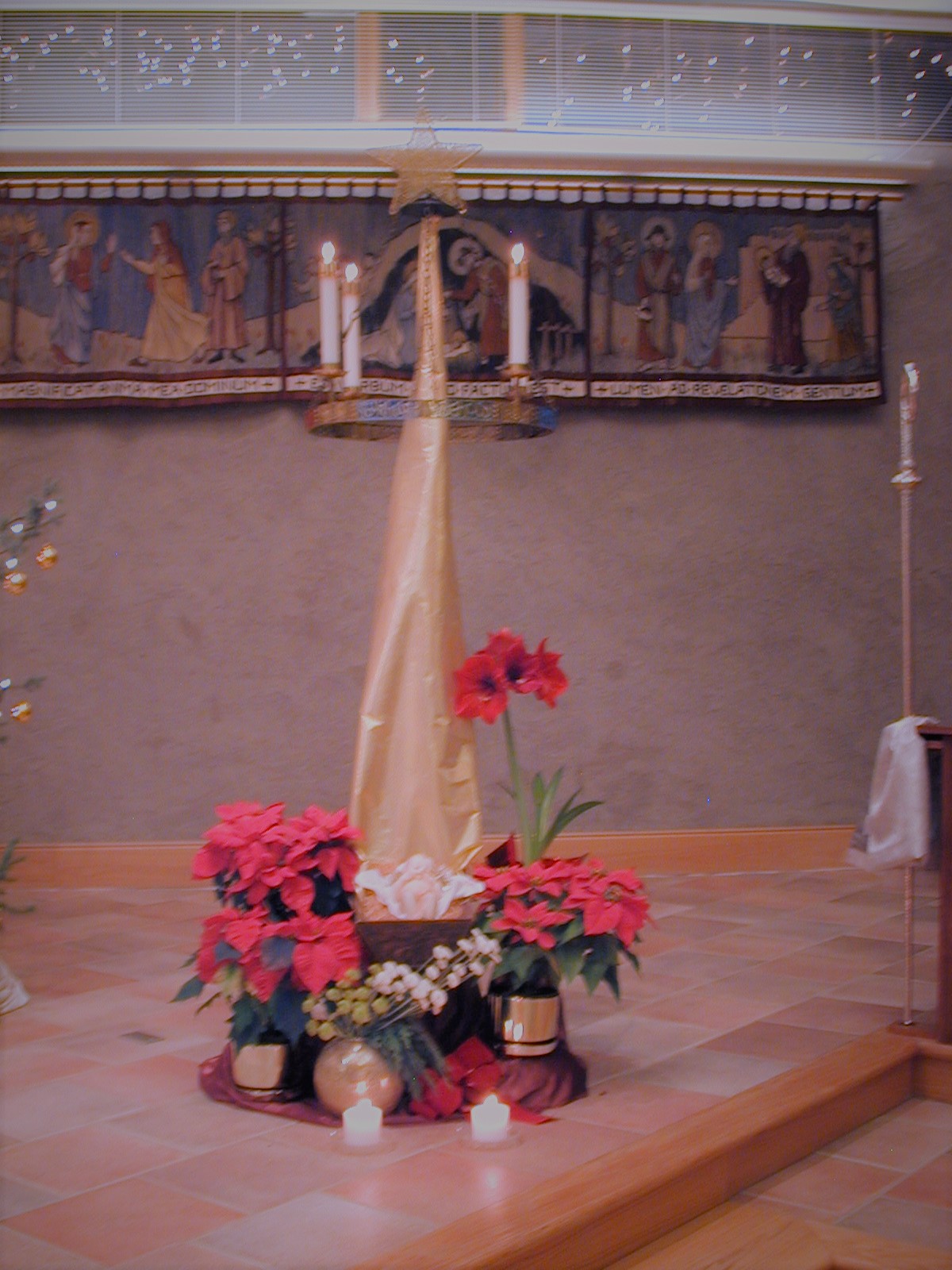


Sunday, December 20, 2020

Promises, Promises, Promises

Emerging as we are from a contentious election, we are moving from the season of promises made to the season of promises kept, or so we hope.  And liturgically, poised on this final Sunday of Advent with Christmas only a few days ahead, we are following the same trajectory. 

Advent has set before us the very long story of God’s promises, first made in the creation itself, of a future when all would be brought to completion.  Since we human beings are key protagonists in the story, there have been a lot of ups and downs.  Only God has remained steadfast.  Stubborn, really, when we consider the many and quite inventive ways that we and our forebears have found to thwart the divine plan for our greatest good.

The promise has remained in place through it all, growing in depth and richness with the passage of time.  Come Christmas, we will celebrate the promise kept—but how oddly!  No sign of the victorious warrior or the glorious king of peace that the prophets have led us to expect.  Instead, a newborn cradled in his mother’s arms beside a cradle full of straw, with ox and ass looking on with interest.  Yes, there are choirs of angels out over the fields of Bethlehem, but their song is brief and apparently unheard except by a handful of shepherds.  Yes, eventually there arrive exotic foreign sages with gifts fit for a king, but they don’t stay long.  Yes, Simeon and Anna identify the six-week-old brought to the Temple by his parents as the promised redeemer, but no one seems to have paid much attention except Mary and Joseph.  Then it’s on to an unreported life of exile off in Egypt, followed by an equally unmentioned life as a village carpenter in Nazareth.  What sort of promise keeping is this?

This is God’s promise keeping, and it unfolds with God’s slow patience through Jesus’ private years and public ministry, still bearing very little resemblance to warrior or monarch.  Or so it seems.  It would take the early believers long pondering, and later believers long theological arguing, to discover that a battle really was fought during those years, a battle that came to a climactic victory in Jesus’ death and resurrection.  But, as we will see during the Easter season, it was a victory without fanfare, victory parades, ticker tape, or endless crowds gathered around the risen Savior, yelling questions and getting sound-bite answers to be broadcast all over the world.  And there was still no sign of throne or crown beyond the cross and crown of thorns whose hidden transformation is sung only obliquely in psalms whose vocabulary is as old as King David’s time and after.  Awash with political fury, murder in the streets, hints of unsettled times still to come, and all under the cloud of a worsening pandemic, we may find it hard to see how the promise has been kept.

Ah, but it has not been fully kept, not yet.  Next year, when Advent begins, we will be reminded once again that the Savior’s triumph over the forces of sin and death is still a work in progress in the history of the world, and perhaps even the cosmos.  The victory was decisive, but, in our human way of reading history, the aftermath will be an unknown time settling until Christ comes again in glory.

Fortunately, we are not called to explain this continuing paradox of the already but not yet.  Traditionally, we call it characteristic of the season of Advent, but in reality it is always with us.  We are not called to explain it, but we are called to live it, with no other light to see by than the one that burned largely unnoticed in Bethlehem, remained unrecognized in the Temple except by two oldsters, and lit the unsung lives of the first believers and all of us who have followed them since the resurrection. It shines still, even in our present darkness, visible only to the eyes of faith.

 Meanwhile, our own lives, lived in the practical ordinariness set out for us by St. Benedict, are the promise being kept.

May your Christmas be bright with God's promise!

 Copyright 2020 Abbey of St. Walburga


Thursday, December 3, 2020

Psalm 46: An Advent Prayer

 This entry was reposted with permission from the new blog at Give Us This Day, https://blog.giveusthisday.org/.  The essay first appeared in the December 2020 issue of Give Us This Day.  New entries from Give Us This Day will be posted daily on the Give Us This Day blog. I encourage you to visit the blog, where you can sign up to receive the post daily by email.  This service is free, but of course the publishers, The Liturgical Press, would be delighted if you would subscribe to the publication itself.  A paid subscription also gives you access to the online (and downloadable) issue.  Since they publish both my essays and my books (just one so far, two more in the works), I like to support them!

Every Advent we hear: this is the season for listening quietly to God’s Word. And every Advent we remember: it is also the busiest season of the year. What to do?  

Psalm 46 offers a suggestive geography. It pictures an outside world where chaos is imagined as earthquake, tsunami, political turmoil, warfare. But there is also an inner world where God’s presence and protective power banish all turmoil. There we can sit quietly and hear ourselves think. The obvious Advent strategy is to find the way into that quiet place within while the holiday-mad world around us is in turmoil. Lucky for those who can, but many of us find it nearly impossible. Are we then shut out of the holy season’s gift?  

Maybe not. What if Advent shifts the strategy? As we prepare to celebrate God’s entry into human history as Word-made-human-flesh, perhaps we could reconsider where we might go to hear God’s Word in the midst of the season’s bedlam. Advent and its Christmas sequel remind us that God’s point of entry was never a silent sanctuary, outward or inward. After long, tumultuous years of promise, the Word arrived in a stable in Bethlehem—a town bursting with incomers who were summoned for a census, a murderous dictator hovering in the background. So wouldn’t it be appropriate to listen for the Word not just within our own hearts but also in the less-than-quiet world around us? What if we learned to recognize the Word in raucous shoppers, quarrelsome family members, and the muttering of homeless people we pass by?  

We might rather not. Our own inner sanctuary offers a quiet retreat, but the surrounding babble invites us into the chaos of real human dramas where we often don’t know how to help. Psalm 46 offers a strategy for that, too, but not the one we usually come up with. “Be still, drop that heavy fix-it toolbox, and just be there where God is.” Learn to hear God’s ever-creating Word spoken in the human voices of expectation and despair, joy and suffering, desire and anger.  

On the Advent doorstep of the Good News made flesh among us, be present, pay attention, listen, and seek to love all those speakers milling everywhere, the welcome and the unwelcome alike. Presence, awareness, listening, and love—God’s fix-it toolbox—are far more powerful than bows, spears, and shields. They are, after all, the tools that Christ, the ultimate Word, brings into the world for our salvation. Let us study them now, in this season of listening—even if only in hurried snatches—so we may learn to put them to use in doing the Gospel’s work year-round.  


Copyright Give Us This Day 2020.  Reprinted with permission.

Wednesday, November 25, 2020

A Lamp in Dark Places


The holiday season is always a patchwork of light and darkness. Some find joy in family gatherings for Thanksgiving and Christmas; others grieve in loneliness the memory of absent loved ones.  Some come together around tables laden with traditional foods lovingly prepared and served; others rely on cafeterias or soup kitchens staffed by strangers to serve  from a limited menu; still others eat alone. 

This year is different.  The darkness is spreading.  Today, as I write on the Tuesday before Thanksgiving, our county goes on red alert and begin strict shutdowns. Last week, the authorities added a few additional restrictions to those required by level yellow security in the hopes of staving off a move to level orange before Thanksgiving.  This morning we are still on enhanced yellow.  At five o’clock, we will jump straight to red.  Personal gatherings of any kind are banned; grocery stores are confined to limited service; restaurants will offer only curbside takeout.  What will happen to the soup kitchens I do not know.  And I doubt that even restaurant and grocery stores dumpsters will have much to offer the homeless who depend on them.

 But St. John’s gospel breaks through the enveloping dark to recall us to hope:  “1In the beginning was the Word, and the Word was with God, and the Word was God. He was in the beginning with God.  All things came to be through him, and without him nothing came to be. What came to be through him was life, and this life was the light of the human race; the light shines in the darkness and the darkness has not overcome it.” The light has a name.  Jesus said“ I am the light of the world. Whoever follows me will not walk in darkness, but will have the light of life” (John 8:12) This is not wishful piety but the deepest truth of our darkest days. 

 These times challenge us to be even more true to our Benedictine identity as people of listening hearts.  It is not so easy to hear the Word of God speaking to us when all the news around us seems bad. But that is precisely what we need to do at times like this.  A number of the psalms we pray in the Liturgy of the Hours remind us that God, not our limited selves or some malicious evil spirit, is in charge of the universe and is to be found always at work there.  See for example Psalm 95, Psalm 100, or Psalm 104.  St. John reminds us that the God whose presence and will permeate the world is not an impersonal force or, again, a destructive enemy.  “God is love,” he says, in no uncertain terms (John 4;7). 

 The times here throw down yet another challenge: how do we recognize or understand the God of love when we are all in danger, when loved ones fall ill and perhaps die, when even the promise of vaccines is darkened by the fear of too-hasty and too-untested distribution, by scientific warnings that the vaccines themselves may have serious negative side effects?  I have no comforting answer to this question. 

 What I do have is a conviction that what we can and must do is what St. Benedict tells us: seek God in all things.  We are not asked to seek explanations for God’s behavior but to look for  every sign of God’s creative presence even in the most unexpected of places.  In the kindness, solicitude and generosity of others; in the courage of sufferers who do not lose faith or hope; in the care offered with consideration and competence by exhausted health care workers; in the community of the afflicted, frightened or bereaved, we look for the threads of light in the darkness.  St. Peter urged the early Christians already beset by conflicts within the community and persecution without “You will do well to be attentive to [God’s word], as to a lamp shining in a dark place, until day dawns and the morning star rises in your hearts” (1 Peter 1:19).  And, says the Book of Revelation, that lamp, like the light it holds, is also a person, the person we cherish above all others, the Christ who transcends all darkness: the heavenly Jerusalem the visionary saw “had no need of sun or moon to shine on it, for the glory of God gave it light, and its lamp was the Lamb” (Rev 21:23).

 We would probably all much prefer an explanation, but God knows that what we need in all circumstances is not concepts too big for us to grasp, but God’s presence and loved  enfleshed in a humanity like our own, apart from sin , so Jesus told his first followers, and us, “…behold, I am with you always” (Matt 28:20).  After all, as we will soon be singing during Advent, that is his other name: “Emmanuel” (Matt 1:23).  And Emmanuel is there among us, with patients, with caregivers, with loved ones, with concerned strangers.  Always.